Bridging Light, Microwaves and Electrons for Precision Calibration
(EPFL, October 30, 2025)
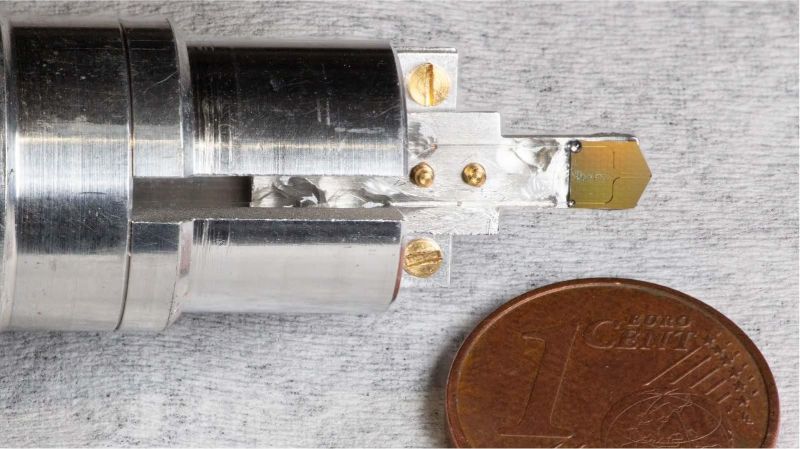 Researchers at EPFL, led by Prof. Tobias Jan Kippenberg, Dr. Thomas LaGrange, and Dr. Fabrizio Carbone, have created a new calibration technique for electron spectrometers. By incorporating a silicon nitride (Si3N4) microresonator chip into a transmission electron microscope, they have achieved a 20-fold increase in accuracy compared to traditional methods. This advancement opens new doors for detailed studies of material properties, chemical bonds, and quantum effects at the nanoscale, potentially transforming our understanding and manipulation of the microscopic world.
The team's method involves shining a continuous-wave laser on the silicon nitride microresonator chip and locking the laser frequency with an optical frequency comb. This process causes free electrons near the chip to interact with the laser's electromagnetic field, modifying the electron spectrum into a comb-like pattern. Such interaction allows for ultra-precise electron spectrometer calibration. EPFL's innovation redefines energy change measurements in electron spectroscopy and also introduces electron-based frequency combs as a powerful tool for future scientific research.
Researchers at EPFL, led by Prof. Tobias Jan Kippenberg, Dr. Thomas LaGrange, and Dr. Fabrizio Carbone, have created a new calibration technique for electron spectrometers. By incorporating a silicon nitride (Si3N4) microresonator chip into a transmission electron microscope, they have achieved a 20-fold increase in accuracy compared to traditional methods. This advancement opens new doors for detailed studies of material properties, chemical bonds, and quantum effects at the nanoscale, potentially transforming our understanding and manipulation of the microscopic world.
The team's method involves shining a continuous-wave laser on the silicon nitride microresonator chip and locking the laser frequency with an optical frequency comb. This process causes free electrons near the chip to interact with the laser's electromagnetic field, modifying the electron spectrum into a comb-like pattern. Such interaction allows for ultra-precise electron spectrometer calibration. EPFL's innovation redefines energy change measurements in electron spectroscopy and also introduces electron-based frequency combs as a powerful tool for future scientific research.